
Journalist argues 'parallel, independent' program claim admits scam; hearing reset to July 2 at 1 p.m.
Each day, 117 Tennessseans criminally convicted by department of revenue fraud under color of TFRL

CHATTANOOGA, Tenn., June 24, 2026 — Tennessee radio journalist suing the department of revenue commissioner on fraud allegations is making arguments at a hearing July 2, a Thursday, 1 p.m., insisting that the fraud under color of financial responsibility convicts 40,832 people a year, most all apart from law.

Oral arguments had been originally docketed Thursday, June 25. In e-mail correspondence with the parties, Cherish Smith, the assistant of chancery court Judge J.B. Bennett, offers no explanation of the delay.
Tennessee commissioner of revenue David Gerregano is arguing that his “independent” and “separate from and parallel to” program of mandatory universal auto insurance complies with the law and serves the general assembly’s policy goals. The claim is intended to hide the fact that DOR contradicts and renders surplus department of safety’s license suspension program under the financial responsibility law.
David Tulis of NoogaRadio Network says that the general assembly’s law doesn’t contain the policy being pursued, and in fact prohibits many of the activities of the department in surveilling auto insurance customers, tagging them as “unconfirmed” and sending them letters of tag suspension.
“I propose that Judge Bennett shutter and decertify the “Eye of Sauron“ and end a longstanding oppression against the people of Tennessee,” Tulis says.

On Monday Tulis filed a reply to Mr. Gerregano’s main brief, and a proposed order, 8 pp.
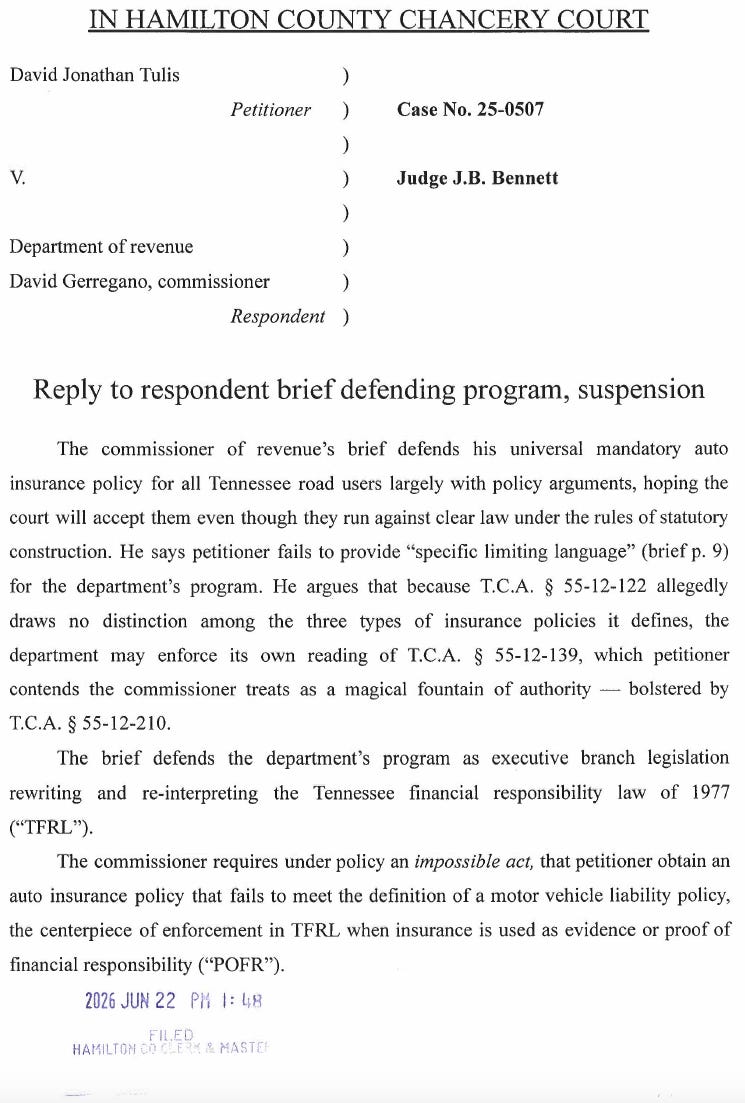

In the proposed order, Judge J.B. Bennett would create an office of special master to reform the department.
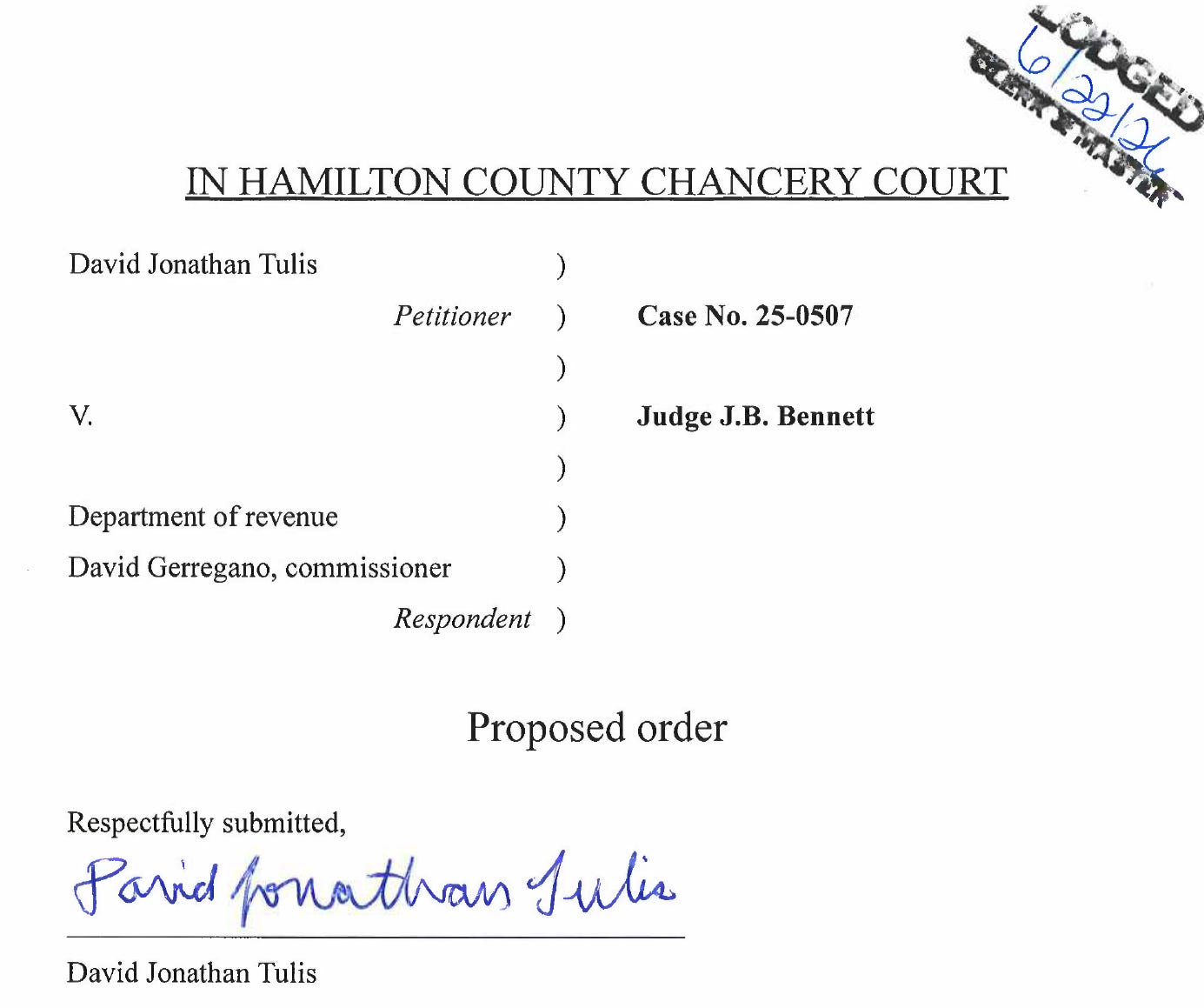
Here’s the draft order offered for court benefit.
Proposed order
****
ORDER DIRECTING COMMISSIONER OF REVENUE TO DECERTIFY ELECTRONIC INSURANCE VERIFICATION PROGRAM
This cause concerns the duty of the commissioner of revenue to accurately administer the Electronic Insurance Verification Program (“EIVP”) over those affected parties made “subject to” the state’s financial responsibility provisions for a stipulated number of years. The purpose of “Part 2 Insurance Verification Program (‘James Lee Atwood Jr. Law’)” (“Atwood”) as stated by Tenn. Code Ann. § 55-12-202 is the verification of motor vehicle liability insurance policies used as proof of financial responsibility. When read and understood in pari materia with “Part 1, Tennessee financial responsibility law of 1977” (“TFRL”), a motor vehicle liability insurance policy verified under Atwood is the same as defined by Tenn. Code Ann. § 55-12-102(7), “‘Motor vehicle liability policy’ means an ‘owner’s policy’ or ‘operator’s policy’ of liability insurance, certified as provided in § 55-12-120 or § 55-12-121 as proof of financial responsibility, and issued, except as otherwise provided in § 55-12-121 by an insurance carrier duly licensed or admitted to transact business in this state, to or for the benefit of the person named therein as insured” (emphasis added).
The Court has reviewed the filings in this case initiated against the Department of Revenue (“DOR” or “Revenue”) under its initial pre-hearing conference order Aug. 7, 2023 (TR Vol. 1, p. 1). It has examined the complaint and determined it is sufficient. It has read petitioner’s brief in support of his cause, has read the commissioner’s brief in response, petitioner’s reply, and other filings. The Court has given due diligence to the four-volume technical record arising from the contested case. It has carefully considered oral arguments made by the parties summarizing this law case in which no material facts are in dispute.
The EIVP operates under the Commissioner David Gerregano certification declaring that the system is running pursuant to the law. Tenn. Code Ann. § 55-12-212. Under the certificate, law-enforcement officers may rely on the program for current information regarding drivers and operators and their required auto insurance. The Court concludes that the complaint raises sufficient doubt that respondent commissioner’s certification of the program is warranted.
The department’s witness testifies that she had not read any of the Tennessee Financial Responsibility Law of 1977, or Part 1, prior to testifying about the program. The Court determines that the certification must be rescinded until the department — which admits it has ignored its obligation to consult with Department of Safety (“Safety” or “DOSHS”) in creating and operating the program — reads the law and comes into compliance with its requirements. Tenn. Code Ann. § 55-12-204, -205.
Tenn. Code Ann. § 55-12-139, cited as basis for every “no insurance” criminal prosecution in Tennessee, indicates the officer uses the program’s electronic insurance verification system (“EIVS”) to verify such policies, pursuant to Tenn. Code Ann. § 55-12-202, insurance contracts as defined in Tenn. Code Ann. § 55-12-102 — that is, certified motor vehicle liability policies.
The concept of financial responsibility presumes that fully emancipated adults in Tennessee are morally upright and financially responsible unless or until they show themselves otherwise. Under the Tennessee Constitution there is a standing presumption of liberty that the state may not curtail absent a justiciable harm or injury for which notice is required. The revocation authority of Revenue is limited to Tenn. Code Ann. § 55-5-117(a)(1)-(5), for fraud. Revocation authority in TFRL resides with DOSHS in which department hearings are held to preserve due process rights under the Constitution. Tenn. Code Ann. § 55-12-103. The safety commissioner “shall administer and enforce this chapter.” The safety commissioner’s authority to revoke and restore is exhaustive. Revenue cannot renew a tag without safety’s “written approval.” Tenn. Code Ann. § 55-12-130.
Revenue uses EIVS to surveil motor vehicle liability policies as recorded by Safety’s financial responsibility division. Revocations after EIVS notifications are ministerial and without hearing.
The Court makes a finding of law that the certified motor vehicle liability insurance policy is central to administration of Tennessee financial responsibility law, Tenn. Code Ann. § 55-12-101 et seq, and -201 et seq, contracts certified as proof or evidence of financial responsibility. Tenn. Code Ann. § 55-12-102(7).
The complaint empowers the Court to discern whether respondent “administrative findings, inferences, conclusions or decisions” in its final order have “prejudiced” petitioner as against the law, whether the disputed program is —
In violation of constitutional or statutory provisions;
In excess of the statutory authority of the agency;
Made upon unlawful procedure;
Arbitrary or capricious or characterized by abuse of discretion or clearly unwarranted exercise of discretion
[Unsupported by material facts]
Tenn. Code Ann. § 4-5-322
The Court finds that the EIVS program operates in excess of statutory authority, violates constitutional and statutory provisions, uses unlawful procedure and is arbitrary and capricious, with a great human toll in prosecutions of members of the public apart from law, the estimate at 40,832 a year, according to the petitioner’s report based on annual reports filings with the General Assembly. Only some of those convicted are parties liable to obtain the motor vehicle liability policy to keep the privilege. Respondent operates EIVS without authority from the facts in the record, primarily that petitioner has not had a qualifying accident nor is under suspension for cause by the Department of Safety in enjoyment of the privilege.
This case arises from appeal in the Department of Revenue as a petition for judicial review under Tenn. Code Ann. § 4-5-322 with a controversy about the law’s scope.
If State of Tennessee suspends a driver license or registration plate for cause, the obligation of the licensee or registrant is to regain the state’s good graces and restore the privilege by meeting the condition of being able to show evidence or proof of financial responsibility. If this suspended person elects the route chosen by most licensees, that is having auto insurance “for the duration of the license’s suspension or revocation” Tenn. Code Ann. § 55-12-114.
Insurance carriers participating in the Tennessee automobile insurance plan, Tenn. Code Ann. § 55-12-136, certify insurance policies using the industry standard form, the SR-22, approved by the commissioner of safety, which document the insurer is required to submit to that department. The insurance company gives notice to DOSHS whether selling, Tenn. Code Ann. § 55-12-102(7) and § 55-12-120, or cancelling such policy, Tenn. Code Ann. § 55-12-123.
EIVS is an electronic mining and sorting utility that helps respondent secure the roadways from careless, irresponsible drivers who cause accidents without means of restoring losses on those they’ve hit or without the willingness to arrange for payment. It monitors those subject parties whose driver licenses Safety suspends for cause who “use a policy of insurance and financial responsibility insurance certificate as proof of financial responsibility under this section.” Tenn. Code Ann. § 55-12-126.
Safety “may issue notice of suspension” for one who “willfully fails, refuses or neglects to make or have filed an accident report” under TFRL’s 20-day reporting requirement after a qualifying accident, Tenn. Code Ann. § 55-12-104. The department suspends a license for an unpaid court judgment involving a motor vehicle, criminal conviction in a traffic case or other cause.
The state’s concern in starting EIVP is upon the person who has violated the privilege trust and who is subsequently obligated to have insurance as security for possible future harm upon others. EIVS is created to monitor this person. The state has an interest in protecting its citizenry from anyone who has demonstrated a lack of financial responsibility, not to impose burdens upon a citizen who is financially responsible.
Plaintiff describes himself as “one of ‘the working poor’” living below the official poverty line (affidavit Oct. 3, 2025, supporting motion for injunction, ¶3). He has no less right to use the public right of way than a wealthy person who buys insurance to protect an investment in an expensive automobile. The power and instrumentalities of government are not — and cannot be — used to exact tribute from travelers with most of the money going to insurance companies and 2½ percent of that profitable stream going as tax revenue to the state. Tenn. Code Ann. § 56-4-205. The Tennessee Constitution and the law passed by the General Assembly do not envision the police power being used to extort the citizenry. Parties who refuse to pay up face tag suspension and criminal prosecution in using their automobiles to go to work, support their families, run their businesses and enjoy constitutional liberties and long-cherished American freedoms.
It is a matter of law in Tennessee the state has mandatory insurance. But it’s compulsory on select high-risk parties, not on the general motoring population whose members have caused no offense to law nor to another member of the traveling or shipping public.
Respondent accepts as fact that plaintiff has not had a qualifying accident nor is he under suspension from Department of Safety. Respondent doesn’t deny his earlier van policy with State Farm insurance company was non-certified. Petitioner admits the policy expired and that he travels without coverage.
DOR uses EIVS apart from law to target motorists who lack non-certified insurance coverage when such individuals enjoy a presumption of financial responsibility and would not otherwise fall under DOR supervision. Tenn. Code Ann. § 55-12-205 orders DOSHS and defendants to use “multiple data elements to make insurance verification inquiries *** accurately.” Absent the use of a filter to distinguish between individuals mandated to have certified SR-22 motor vehicle liability policies and those who are not required to produce the same, responsible citizens are included in EIVS absent statutory authority. No part of TFRL allows the department to create a list of insurance industry non-customers by matching corporate customer data and the department’s list of vehicle identification numbers.
Enforcement of respondent’s universal mandatory auto insurance policy is premised on misinterpretation of a single sentence: “This part shall apply to every vehicle subject to the registration and certificate of title provisions” Tenn. Code Ann. § 55-12-139. The rules of construction require this provision to be read in pari materia with § Title 55, chapter 12, which defendants do not.
The doctrine requiring this provision to be read in context is called the rule ejusdem generis, that “when a general term follows a specific one, the general term should be understood as a reference to subjects akin to the one with specific enumeration.” Norfolk & W. Ry. Co. v. Am. Train Dispatchers Ass’n, 499 U.S. 117, 129, 111 S. Ct. 1156, 1163, 113 L. Ed. 2d 95 (1991), or where “a more specific statutory provision takes precedence over a more general provision,” with judicial rules noting “[a] construction which places one statute in conflict with another must be avoided” Graham v. Caples, 325 S.W.3d 578, 582 (Tenn. 2010). The department revises the rule to say, “A more general provision takes precedence over a specific statutory provision.” This sentence in sect. 139 applies to persons required to have proof of financial responsibility.
“[Insurers] of record” give notice to Safety when an insured cancels or fails to renew an SR-22 policy. This person thus becomes “eligible” for the four-notice sequence described in Tenn. Code Ann. § 55-12-210. At the end of a suspension, the person is “[released] from the requirement” to have evidence or proof of financial responsibility. Tenn. Code Ann. § 55-12-126. The Court finds that Revenue does not use Safety’s financial responsibility division records of certified policies sent by insurers of record to form the basis of EIVP verification.
The standard of review in a contested case under the uniform administrative procedures act at Tenn. Code Ann. § 4-5-322 directs the Court to determine that the pleadings in instant case strongly favor petitioner’s reading of the law as opposed to the department’s interpretation.
Petitioner meets his burden of proof in petitioning for restoration of his right to the tag under the law and an end of the program that deprives him of his enjoyment of the registration privilege.
The Court hereby ORDERS that respondent:
Withdraw his certification of EIVP pursuant to Tenn. Code Ann. § 55-12-212;
Cease immediately the use of EIVS until the Court is satisfied that the department has read the Tennessee Financial Responsibility Law of 1977 and is willing to comply with its requirements;
Notify all law-enforcement departments in Tennessee of the cessation of the use of EIVS;
Halt forthwith use of the U.S. mails in sending inquiry and suspension notices to any registrant who is not in the DOSHS record as having agreed, on payment of fines and fees, to purchase a certified SR-22 motor vehicle liability policy to retain the operating privilege after a driver license suspension;
Recalibrate EIVS to verify motor vehicle liability insurance policies;
Rescind any act of registration suspension of any person not subject to TFRL, such act commencing on or after 12:01 a.m. May 19, 2023, the date of respondent’s first “request for information” notice sent to petitioner; and
Order DOR’s agent in Hamilton County, the county clerk, to send by U.S. mail or remit to petitioner in person a one-year sticker for renewal of plaintiff’s 2000 Honda Odyssey minivan, VIN 2HKRL1859YH575510, on condition of payment of the annual fee, the one year tolling from the date of this order.
Petitioner starting at Petition for Judicial Review and Complaint for Injunctive Relief ¶105 requests relief that will allow the department to restart the EIVP in compliance with law. The Court believes respondent should be able to recalibrate EIVS in short order.
It will take much longer, however, for the Court’s victim restitution program and renewal at the agency to be completed.
Petitioner at ¶118 of the complaint demands extensive “injunctive relief, corrective action.” Restitution and remediation. Public notice and awareness. Compensation payment program. Update for prosecution rules. Driver license application update. Consultations with General Assembly. Consultations with Department of Safety.
Tennesseans are wrongly convicted in criminal court under Commissioner Gerregano’s program. Many have suffered other follow-after criminal prosecutions on account of their suspended tags. Harm to the public is great. A reckoning is in order. The remedy envisioned by the Court is comprehensive.
It is reasonable thus for the Court to assign a special master under Tenn. R.Civ. Proc. 53. This judicial monitor will work under the Court’s direction, be paid by the state and be accountable for progress toward resolution of the controversy. Reforms under this office will prevent future harm of petitioner and correct a longstanding and widespread breach.
The petitioner may choose to join the commissioner of safety in the case. The special master has authority to hold hearings and settle disputes between or among petitioner, respondent and parties joined. The special master will operate by report giving notice of progress in restoring a just and law-abiding relationship between the state and the people of Tennessee.
Further, in matters of scheduling, the Court orders the parties to:
Arrange a hearing regarding the scope of the special master’s assignment;
Prioritize the order of reforms required in the respondent department;
Arrange for a hearing regarding petitioner’s demand for expenses including his reasonable legal fee after he submits an invoice to the Court.
SO ORDERED.
amazing 👏 🤩